


EXHIBITIONS
Julie Hayashi Sawari : Before It Appears, Gathering a Touch
2026.2.7 [sat] – 2.28 [sat]
YUKIKOMIZUTANI
web用-1.jpg)
Julie Hayashi, Where the Wind Passes [shimogamo], 530 × 727mm, Kumohada washi paper, gold leaf, ink, mineral pigments, 2025
YUKIKOMIZUTANI is pleased to present a solo exhibition by Julie Hayashi, Sawari : Before It Appears, Gathering a Touch, on view from Saturday, February 7 through Saturday, February 28, 2026. Julie Hayashi’s practice has long centered on themes of “that which emerges of its own accord” and “that which is in flux.” Beginning with her research into the “nijimi (blurring)” and “tarashikomi (dripping)” techniques found in Edo-period Rinpa painting, Hayashi has developed a deep interest in the philosophy of “jinen” —a concept of nature as self-arising. Her work navigates the space between the artist’s intentional act of painting and the phenomena that materials themselves generate, engaging in a quiet dialogue with nature.
This exhibition marks Hayashi’s first solo presentation at YUKIKOMIZUTANI. While continuing the conceptual foundation of her ongoing Sawari series—rooted in the Rinpa notion of “that which becomes naturally,” or a sensibility of entrusting oneself to natural processes—the exhibition also reflects on bunjin culture, which flourished from the late Edo through the Meiji period. The new works presented here are informed by Hayashi’s experiences of travel and observation.The term “sawari” originates from shamisen music, referring both to a noise component and to the essential point or resonance that defines a sound or phenomenon. As Hayashi travels to different regions, she perceives the atmospheres and sonic traces that arise within her as “sawari”, translating them into paintings as if notating a musical score. We invite viewers to experience this new series at the gallery.
Artist Statement
Silence is listening.
Before the world emerges as form or meaning,
nature is already quietly resonating.
As the literati once did,
I travel from place to place,
entrusting myself to each site as I paint.
Even before setting out on a journey,
its presence begins to rise;
the yet-unseen landscape draws quietly near to me
on the night before.
When I paint, I remain beside the time enacted by nature,
sometimes calling out to it,
gently gathering the faint sawari—
that which lies just before emergence—
and scoring it as one would music.
The works become traces of movement
between myself and nature.
And once they take form as works,
like musical scores,
they bring forth new resonances once again.
-1.jpg)
Floating on the Water, 455×530 mm, Kumohada washi paper, tin foil, ink, mineral pigments, 2025
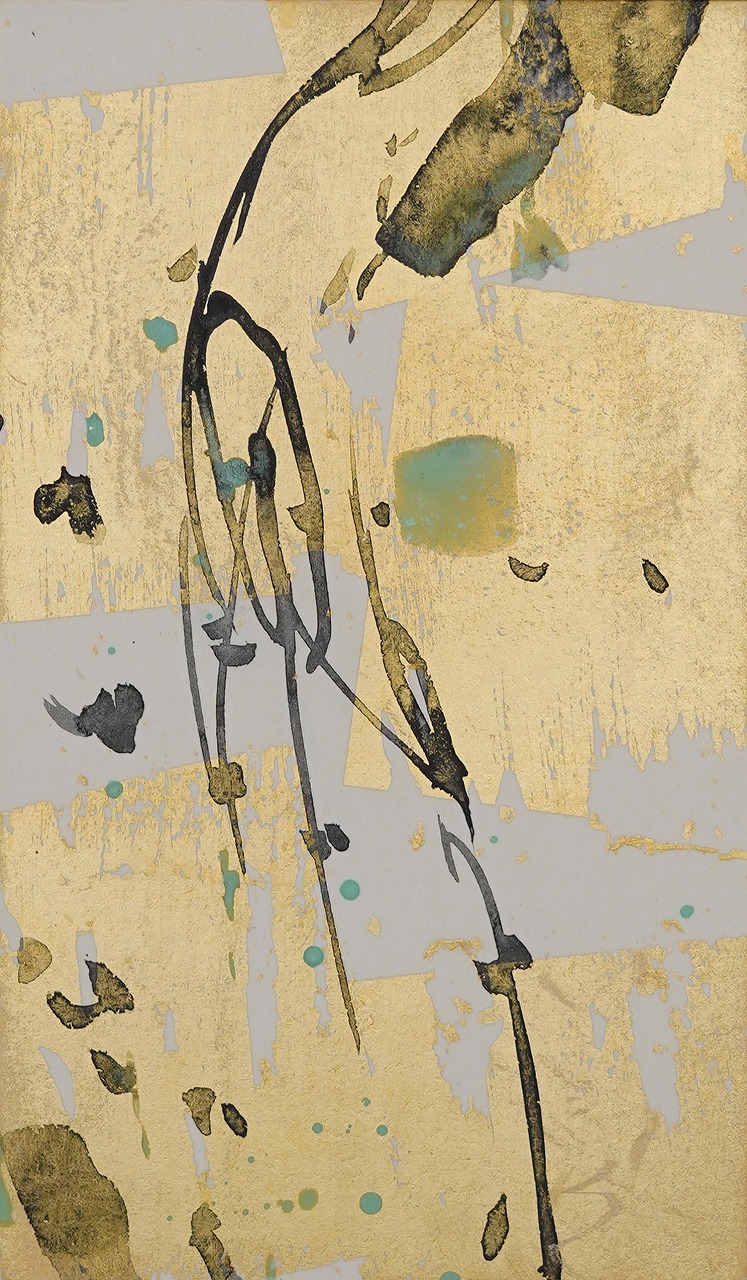
Echoes of the rain no.2, 273×160mm, Kumohada washi paper, gold leaf, ink, mineral pigments, 2025